


Inverse Intelligence Group
We turn forward models upside down
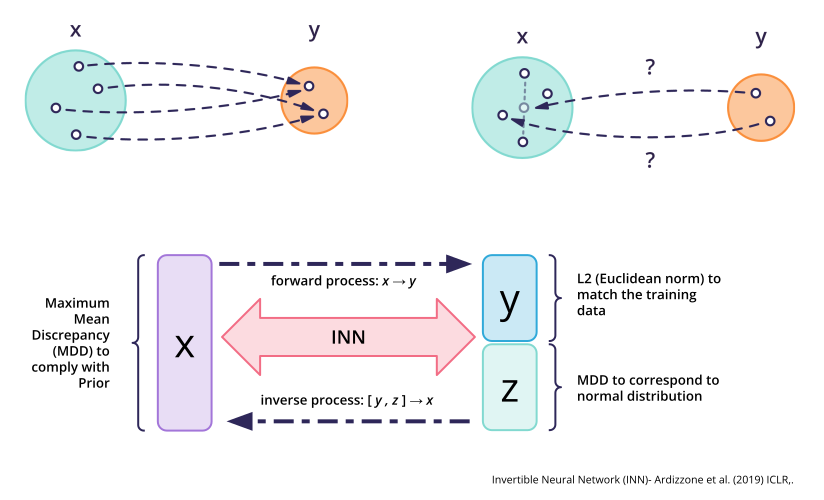
If you cannot clearly assign the cause to measured data, then you are dealing with inverse problems. Our team of experts in physics and data science can help: Using invertible neural networks and scientific AI, we turn your measurement noise into understandable parameters and simulations into predictive sensors.
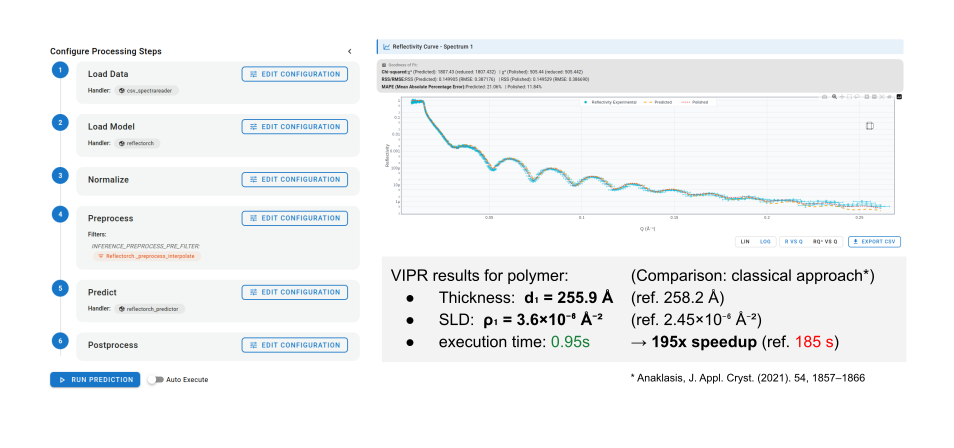
We make ambiguous measurement and process data from industrial plants finally analyzable - through the development and integration of AI solutions. Our open VIPR Inversion Engine delivers Bayesian inference/inversion, uncertainty quantification, virtual sensing, real-time alerting, and fully integrable REST interfaces – production-ready, transparent, and modularly extensible. We combine physical understanding, scientific machine learning, and productive implementation to help industrial companies and applied research institutions gain robust insights and control logic from the most complex data.
Inverse problems we have solved

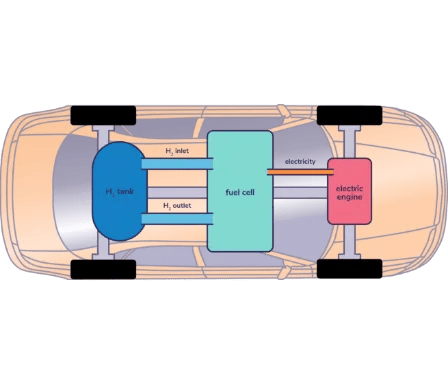
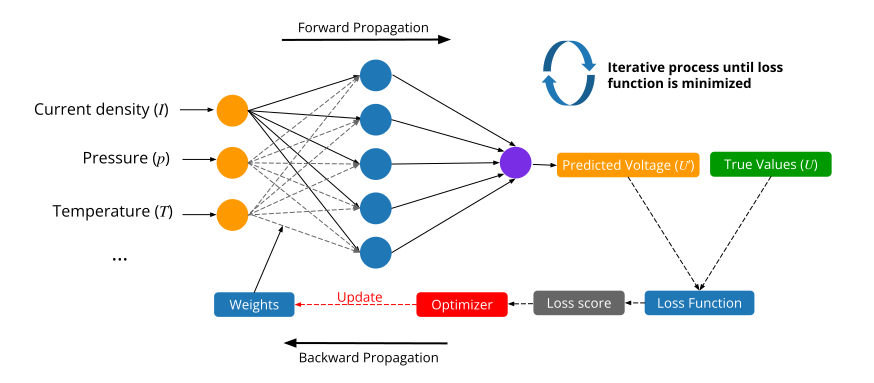
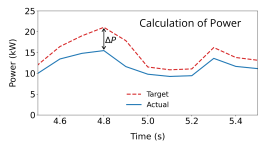
Services
We develop complete AI-based analysis and process intelligence for industrial measurement systems:
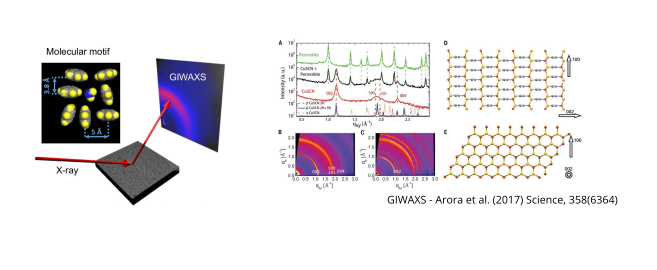
Development, training, and adaptation of invertible models for layer thicknesses, material parameters, plasma states, sensor drifts, and other ambiguous measurement processes.
Planning and construction of data pipelines, data models, data collection, robustification, and automated data management.
Generation of training data using physical models or generative models – ideal when data is scarce or expensive.
Implementation of a modular analysis and control pipeline based on our open-source VIPR framework. With REST API, plug-ins, alerting, and dashboards.
Seamless integration into existing systems, measurement device software, automation systems, or edge infrastructure.
Our Working Method
- Formulation of the inverse or data-driven problem in physical context
- Analysis of relevant mechanisms, boundary conditions, and measurement chains
- Identification of reconstructable quantities and necessary diagnostics
- Structured recording of measurement, process, and metadata
- Synchronization, filtering, calibration, and quality checking
- Extraction of physically significant features and time regimes
- Selection of suitable model architecture (e.g., Invertible Neural Network, Physics-informed Neural Network, Bayesian Inference)
- Integration of physical constraints and process knowledge
- Training with real, synthetic, or hybrid datasets, possibly on high-performance computers
- Provision of the model as a scalable API or edge component
- Connection to measurement systems, controls, and data services
- Secure operation via REST, gRPC, or OPC-UA
- Experimental verification of reconstructions and predictions
- Analysis of uncertainties, robustness, and real-time capability
- Iterative adjustment based on pilot data and expert feedback
- Deployment in target environment with monitoring and versioning
- Continuous model monitoring, drift detection, and re-training
- Technical support, documentation, and continuous optimization
We are more than just another AI agency
We are not just an AI agency on cloud nine. We are physicists, machine learning engineers, scientists, innovators, and we work in a practical manner. We combine science-driven AI with a deep understanding of processes and systems. With open frameworks like our VIPR Inversion Stack, Bayesian inference, physics-informed neural networks, and normalizing flows, we build transparent, auditable, and industry-ready pipelines that seamlessly link measurement data, simulations, and automation systems. This creates solutions that enable robust state reconstructions, secure process control, and scalable integrations, far beyond what traditional AI agencies deliver.


What Distinguishes Us
Scientific Machine Learning
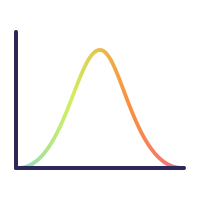
Bayesian Inference
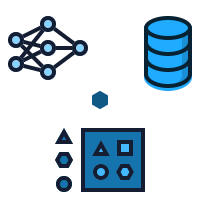
Understanding Complex Systems
Open Source Frameworks
Measurement and Automation Technology
We integrate AI models into industrial measurement and automation systems. This includes:
- Multi-sensor fusion
- Real-time state reconstruction
- REST and edge deployments
- Feedback to control systems
We connect modern AI with proven measurement technology and automation to make processes more robust, adaptive, and predictable.